
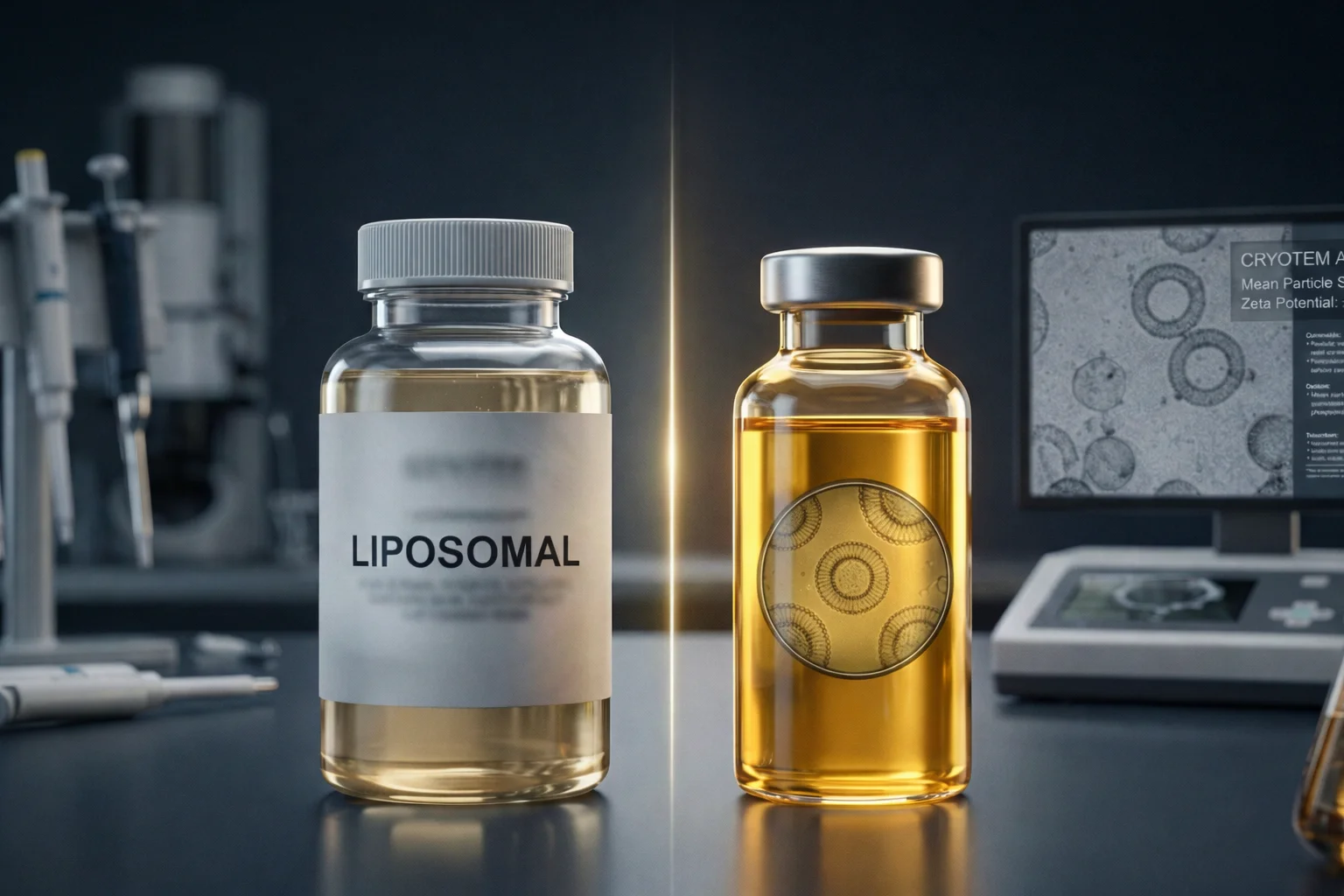
The nutraceutical industry faces a troubling reality: most liposomal supplements available today contain no actual liposomes whatsoever [3]. This discovery concerns us deeply because authentic liposomal delivery can boost nutrient bioavailability up to 90%, while traditional formulations struggle to achieve even 20% absorption [10]. Research shows that properly manufactured liposomal products deliver 4-5 times superior absorption compared to conventional supplements [10]. The complexity lies in liposomal validation—a highly technical and costly process that many manufacturers avoid [3].
Consumers deserve transparency about what constitutes genuine liposomal supplements and whether these formulations truly offer superior benefits. We understand the frustration of navigating marketing claims that promise enhanced bioavailability without delivering results. This guide examines the structural differences between authentic and counterfeit products, offering practical verification methods to identify legitimate liposomal glutathione supplements and other nutraceutical formulations.
Most importantly, we address whether liposomal supplements justify their premium pricing when manufactured with proper care and expertise. Our goal is to empower you with the knowledge needed to make informed decisions about these specialized nutraceutical products.
Liposomes represent spherical vesicles composed of one or more phospholipid bilayers that enclose an aqueous core [3]. The name derives from Greek words “lipo” (fat) and “soma” (body), accurately describing these microscopic structures that replicate cell membrane architecture [3]. Size specifications matter significantly – while liposomes can range from 50 to 1000 nm, optimal nutraceutical formulations measure between 50-150 nm to achieve improved cellular interaction and stability [3] [3].
The structural foundation relies on phospholipids as building blocks. Each molecule features a hydrophilic (water-loving) head group paired with hydrophobic (water-repelling) fatty acid tails [4]. Water exposure triggers spontaneous self-assembly into bilayer sheets [1]. The hydrophobic tails orient toward each other while hydrophilic heads face the aqueous environment, forming thermodynamically stable closed vesicles [1].
Quality liposomal supplements typically employ phosphatidylcholine as the primary phospholipid. Manufacturers often add cholesterol to stabilize membranes and control nutrient release patterns [12] [3]. This composition closely mirrors natural cell membranes, explaining their excellent biocompatibility [7].
The amphiphilic structure creates unique encapsulation capabilities. Liposomes can hold hydrophilic compounds within their aqueous core while accommodating hydrophobic molecules in the lipid bilayer [3] [3]. This dual-phase loading distinguishes them from conventional delivery systems.
Protection becomes critical during digestion. The phospholipid shell shields nutrients from stomach acid, digestive enzymes, and intestinal flora [12]. Many nutrients would otherwise degrade completely before reaching absorption sites [12].
Cellular uptake follows two main pathways. Endocytosis, specifically pinocytosis, allows cells to engulf the entire liposomal structure [5]. Alternatively, the phospholipid bilayer can fuse directly with cell membranes, releasing contents into cells [3]. The lymphatic system offers another absorption route, allowing liposomes to bypass first-pass liver metabolism that typically breaks down nutrients before systemic circulation [6] [12].
Clinical evidence supports substantial bioavailability improvements with proper liposomal formulations. Research demonstrates that liposomal multinutrients deliver significantly elevated vitamin C concentrations from 1 to 8 hours post-ingestion, plus higher zinc levels from 0-6 hours compared to non-liposomal versions [7]. Studies document bioavailability increases of 2-5 times over traditional supplements [6][2].
The protective mechanism reduces gastrointestinal irritation by preventing direct nutrient contact with intestinal walls [12]. Liposomal iron exemplifies this benefit, achieving bioavailability 3-4 times greater than conventional forms [3]. Pharmacokinetic analysis confirms that liposomal supplements modify nutrient appearance and clearance patterns in blood, supporting enhanced absorption profiles [24].
Specnova’s independent testing exposes a disturbing truth: 95% of products marketed as liposomal contain no actual liposomes [13]. Regulatory bodies have taken notice. The Advertising Standards Authority ruled against YourZooki’s libosomal vitamin C claims when particle tracking analysis failed to demonstrate liposome presence [3]. Abundance & Health’s September 2020 testing detected zero liposomes in YourZooki’s product [10]. One commercially available supplement contained merely 4% of its claimed vitamin C levels [3].
Brand analysis across multiple products reveals significant variability in particle size and polydispersity index among supplements advertised as liposomal [3]. Testing identified one supplement with oversized particles and no detectable levels of the advertised ingredient [3].
Authentic liposomes possess a phospholipid bilayer structure created by double-chain amphiphilic molecules [4]. Micelles form single-layer spheres from single-chain amphiphiles [12]. The bilayer configuration separates genuine liposomes from basic emulsions [7].
Manufacturers often market emulsions or micelles as liposomal products despite lacking the characteristic bilayer membrane [7]. Some companies claim “liposomal” applies to any product containing phospholipids, regardless of actual liposome formation [3].
The supplement industry lacks regulation around “liposomal” terminology, permitting unverified claims [13]. Brands frequently add phospholipids or vegetable oils to formulations and apply liposomal labels without creating actual liposomes [4]. Genuine liposomal manufacturing demands specialized equipment and controlled conditions, significantly increasing costs [7].
Products priced like regular supplements (USD 10-15) rarely contain liposomes, while authentic versions typically begin at USD 30 [7]. Absorption claims stating “90%” or “nearly identical to IV” lack peer-reviewed validation [4]. Proprietary blends conceal actual nutrient quantities from consumers [4].
Proper liposomal verification demands rigorous laboratory testing that many nutraceutical manufacturers avoid due to cost and complexity. We recognize the challenge brands face when selecting reliable contract manufacturing partners who can provide authentic documentation. Several specific tests separate genuine liposomal products from misleading formulations.
Cryo-Transmission Electron Microscopy stands as the gold standard for directly observing, analyzing, and measuring liposomes in aqueous solutions [14]. This technique rapidly freezes samples at liquid nitrogen temperature, preserving native structure without distortions from air drying [14]. Authentic liposomes display a characteristic trilamellar membrane profile under Cryo-TEM [15]. The imaging confirms spherical morphology, particle distribution, and structural integrity [16]. Scanning Electron Microscopy evaluates external liposome surfaces, while Cryo-TEM reveals internal layered structures [2].
Quality nutraceutical manufacturing requires this level of structural validation. Brands partnering with contract manufacturers should request these imaging results as standard documentation.
Optimal liposomal nutraceuticals measure between 100-200 nanometers [2]. Particles below 100 nm lack FDA approval for oral use due to safety concerns about bypassing digestive processes [15]. Particles exceeding 200 nm face rapid clearance by the liver [15]. Dynamic Light Scattering Analysis verifies size, with smaller particles providing increased bioavailability and improved stability [2]. Research shows cellular uptake mechanisms vary significantly across size ranges, with 40-276 nm liposomes exhibiting different absorption pathways [8] [17].
Encapsulation efficiency above 70% indicates successful nutrient loading [15]. This metric measures the percentage of active ingredients successfully entrapped within liposome structures [18]. High-performance liquid chromatography quantifies encapsulated versus free nutrients after separation [19]. Formulations achieving 79-93% encapsulation efficiency demonstrate superior carrier capacity [20] [21].
Contract manufacturers who prioritize quality provide detailed encapsulation data for every batch, ensuring consistent product performance.
Zeta potential measuring ±30 mV or higher prevents particle aggregation and ensures formulation stability [9] [22]. This electrical charge measurement predicts whether liposomes remain dispersed or clump together during storage [23]. Values below ±20 mV indicate short-term stability only, while readings under 5 mV lead to rapid aggregation [9].
Clinical pharmacokinetic studies measure actual nutrient absorption by tracking plasma concentrations over time [24] [25]. Authentic products demonstrate significantly elevated blood levels compared to standard supplements, with area-under-curve values confirming enhanced delivery [21][224].
Brands deserve partners who conduct rigorous bioavailability testing to validate their nutraceutical claims and protect consumer trust.
Quality manufacturers willingly provide Transmission Electron Microscopy analysis that proves bilayer structure [10]. Dynamic Light Scattering alone cannot confirm liposome presence [10]. Ask for third-party verification documentation and independent clinical trial results [10]. Manufacturers must demonstrate high phosphatidylcholine content, as different qualities directly affect liposome stability [10]. Most importantly, request proof that liposomes actually contain the stated nutrient, not just phospholipids [10].
Watery consistency reveals insufficient phospholipids or substandard quality [10]. Genuine products appear as liquids or gels—never capsules [10]. Single-dose sachets minimize oxidation compared to bottles that require repeated opening [10]. Proprietary blends conceal actual ingredient amounts, preventing proper verification [26]. Products priced under USD 30 almost certainly contain no liposomes, given that authentic manufacturing demands expensive specialized equipment [7].
Standard supplements typically achieve 10-40% absorption rates [11]. Quality liposomal formulations can reach 50-90% absorption, depending on the specific nutrient and formulation expertise [11]. This enhanced delivery often allows 30-50% dosage reductions compared to conventional forms [11]. Individuals with digestive concerns, malabsorption issues, or those over 50 experience the greatest benefits [11]. Nutrients that already absorb well may not justify liposomal delivery [27].
Liposomal supplements typically cost 20-60% more than traditional versions [11]. The meaningful metric remains price per absorbed nutrient, not price per capsule [11]. Higher manufacturing costs reflect phospholipid materials, specialized equipment requirements, and extensive stability testing [11].
We recognize that authentic liposomal supplements offer exceptional bioavailability benefits, yet the nutraceutical market contains predominantly mislabeled products lacking genuine liposome structures. Consumers deserve better protection from misleading claims that exploit trust in advanced delivery technologies.
Smart buyers should demand Transmission Electron Microscopy documentation, particle size verification, and encapsulation efficiency reports before making purchases. Products priced below $30, presented in capsule formats, or displaying watery consistency signal potential fraud.
The investment in verified liposomal formulations rewards those who prioritize quality over convenience. However, success depends entirely on rigorous validation that distinguishes legitimate nutraceutical innovations from costly marketing deceptions. We encourage consumers to apply these verification methods consistently, ensuring their supplement choices deliver the promised therapeutic benefits they seek and deserve.
[2] – https://www.wbcil.com/blog/liposomal-nutraceuticals-8-myths-vs-reality/
[3] – https://en.wikipedia.org/wiki/Liposome
[4] – https://pmc.ncbi.nlm.nih.gov/articles/PMC12321603/
[5] – https://www.sciencedirect.com/topics/neuroscience/liposome-membrane
[6] – https://www.news-medical.net/life-sciences/What-is-a-Liposome.aspx
[8] – https://pmc.ncbi.nlm.nih.gov/articles/PMC7151102/
[9] – https://pmc.ncbi.nlm.nih.gov/articles/PMC12298344/
[10] – https://pmc.ncbi.nlm.nih.gov/articles/PMC10347199/
[13] – https://www.sciencedirect.com/science/article/pii/S1756464625004451
[14] – https://specnova.com/lipovantage/truliposome-validation/
[17] – https://cot.food.gov.uk/Uncertainties surrounding novel supplement formulations
[18] – https://www.topsante.co.uk/news/fake-liposomal-supplements-popular-company-misled-consumers/
[22] – https://effepharm.com/identifying-authentic-liposomal-products-key-tips/
[25] – https://www.bodyspec.com/blog/post/liposomal_supplements_complete_guide_to_enhanced_absorption
[26] – https://www.astm.org/e3143-18b.html
[27] – https://nutraceuticalbusinessreview.com/the-nad-liposome-problem-supplement-science-vs-marketing
[29] – https://pubmed.ncbi.nlm.nih.gov/24092051/
[32] – https://www.sciencedirect.com/science/article/abs/pii/S0021967321008104
[33] – https://www.sciencedirect.com/science/article/pii/S0021967321008104
[34] – https://pmc.ncbi.nlm.nih.gov/articles/PMC5039444/
[35] – https://pmc.ncbi.nlm.nih.gov/articles/PMC9503861/
[36] – https://www.pharmavalidation.in/zeta-potential-validation-in-liposomes-manufacturing/
[37] – https://www.izon.com/news/the-critical-role-of-zeta-potential-measurements-in-advancing-medicine